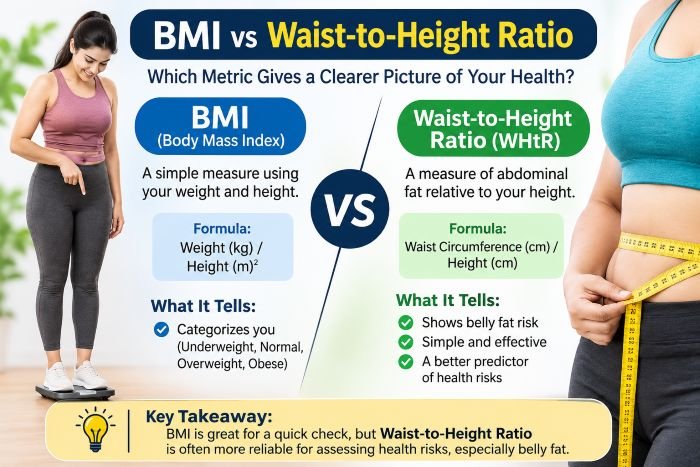
BMI has been the go-to number for judging healthy weight for decades. But many doctors and researchers now also recommend a simpler measure: waist-to-height ratio. Both are quick and free, and each tells you something different. Here’s how they compare.
What is BMI?
Body mass index (BMI) is your weight in kilograms divided by your height in metres squared.
BMI = weight (kg) ÷ [height (m) × height (m)]
For most adults, the World Health Organization classifies a BMI of 18.5–24.9 as healthy, 25–29.9 as overweight and 30 or above as obese. Some Asian health guidelines use lower cut-offs because health risks can appear at lower BMI levels.
You can check yours instantly with a quick BMI calculator.
What is waist-to-height ratio?
Waist-to-height ratio (WHtR) is your waist circumference divided by your height, using the same units.
WHtR = waist (cm) ÷ height (cm)
A widely used guideline is to keep your waist to less than half your height, a ratio under 0.5.
Example: height 170 cm, waist 90 cm → 90 ÷ 170 = 0.53, which is above the 0.5 guideline.
Why waist size matters
Fat stored around the abdomen, especially around internal organs, is more strongly linked to type 2 diabetes, high blood pressure and heart disease than fat stored elsewhere. BMI can’t tell where fat is stored; waist measurements can.
Comparing the two
| Factor | BMI | Waist-to-height ratio |
|---|---|---|
| What it measures | Weight relative to height | Belly size relative to height |
| Shows fat location | No | Yes (abdominal fat) |
| Muscular people | Can overestimate risk | Less affected |
| Simple guideline | Category ranges | Keep waist under half your height |
| Tools needed | Scale + height | Tape measure + height |
When BMI can mislead
- Muscular people may be classified as overweight despite low body fat.
- Older adults may have a “normal” BMI while having low muscle and more fat.
- People with “normal” BMI but a large waist may still face higher metabolic risk.
How to measure your waist correctly
- Stand straight and breathe out normally.
- Find the point midway between your lowest rib and the top of your hip bone.
- Wrap a tape measure around, keeping it level and snug but not tight.
- Read the measurement without holding your breath in.
Which should you use?
Use both. BMI gives a quick weight-for-height check; waist-to-height ratio adds information about where fat is stored. Together, they provide a clearer picture, especially alongside blood pressure, blood sugar and cholesterol tests.
Frequently asked questions
Does waist-to-height ratio work for children?
It’s been studied in children too, but paediatric assessment should be guided by a doctor using age-appropriate charts.
Is BMI outdated?
No. It’s still useful for screening large groups and tracking trends, but it works best with other measures.
How often should I measure?
Every few months is enough to track meaningful changes.
Final thoughts
BMI and waist-to-height ratio are complementary tools, not rivals. Check both, discuss results with your doctor, and focus on sustainable habits rather than chasing a single number.
This article is general information and not medical advice.